Opinion
From Chaos to Consolidation, why brand remains the ultimate moat

Väinö Leskinen
Chief Consulting Officer
New markets do not reward the best technology. They reward the company that can actively design and shape the market perception to match their strengths.
Every technological revolution follows a familiar trajectory. The internet did it. Mobile computing did it. Cloud did it. Crypto did it in dramatic fashion. Generative AI is repeating the cycle. Quantum will follow with similar rhythms and different vocabulary. The story begins with abundance and promise. It ends with consolidation and hierarchy. The middle is turbulence.
The early phase feels explosive. A commercial Cambrian moment produces hundreds of startups with similar claims and similar technology. Many are separated only by personality, language, or the visual confidence of their brand. The customers try to understand what is being offered and how it is useful. The companies attempt to explain what makes them special. Neither side has the full picture.
“New markets do not reward the best technology. They reward the company that can actively design and shape the market perception to match their strengths.”
Three AI and data engineering companies shared a contrarian belief: the best intelligence is co-created. Superpositioning turned collaboration from a capability into an identity, aligning culture, narrative, and behavior. Reputation formed quickly as Norrin became legible as a collective intelligence, not a vendor.
Then the contraction arrives. Money becomes selective. Time becomes real. The market quietly retires the products it never truly needed. Companies disappear without scandal and without legacy. They are not defeated by a competitor. They are displaced by indifference.
What follows is the long middle. The zombie period. There is traction without profitability. Growth without margins. These companies sell aggressively below cost to claim momentum that may not exist. They are products with payrolls. Features disguised as firms.
The breakout belongs to the organizations that understand a hard truth. Technology is not a moat. It is a starting line. The companies that endure build gravity around themselves. They turn customers into communities. They turn usage into dependence. They turn adoption into advantage. Network effects take shape. Switching costs rise. Scale begins to matter. A market becomes an industry.
“The breakout belongs to the organizations that understand a hard truth. Technology is not a moat. It is a starting line.”
Eventually consolidation arrives because complexity exhausts customers and capital alike. A leader emerges. A challenger finds its moment through merger or momentum. A specialist claims a profitable niche with discipline and patience. Everyone else becomes a memory.
Stainless steel was everywhere but understood nowhere. World As Our Showroom reframed Outokumpu from a commodity manufacturer into a catalyst for industrial evolution, using the built world itself as proof. Reputation shifted first, momentum followed, and brand emerged as a point of view rather than a product.
Reputation Builds Momentum.
Brand Builds the Moat.
When the technology is similar and the talent overlaps and funding is widely available, what separates the companies that endure from the companies the market forgets?
Reputation. Not image. Reputation superpositioned to perform as brand.
Reputation is not surface. It is substance remembered. It is the market’s expectation of how you will act, deliver, and adapt. It is trust formed from signals repeated over time.
Reputation creates momentum. Momentum attracts capital. Momentum attracts customers. Momentum attracts talent who want their future to rise with yours. Momentum is the precursor to every advantage. Network effects require belief. Switching costs require confidence. Moats require time. Momentum buys that time.
“Superpositioning is the discipline of preparing reputation to stretch into brand.”
Outokumpu Circle Green did not launch as a greener option but as evidence that steel itself could evolve. Superpositioning aligned product truth with a broader industrial narrative, allowing reputation to lead adoption. Momentum showed up in search behavior before it appeared in brand metrics.
Superpositioning is the discipline of preparing reputation to stretch into brand. It aligns narrative and capability so that when opportunity arrives, the company appears ready, believable, and inevitable.
Brand is what reputation becomes once proven. Brand is reputation with a track record. Brand is reputation that compounds. Brand is momentum that has acquired so much mass that it begins to defend itself.
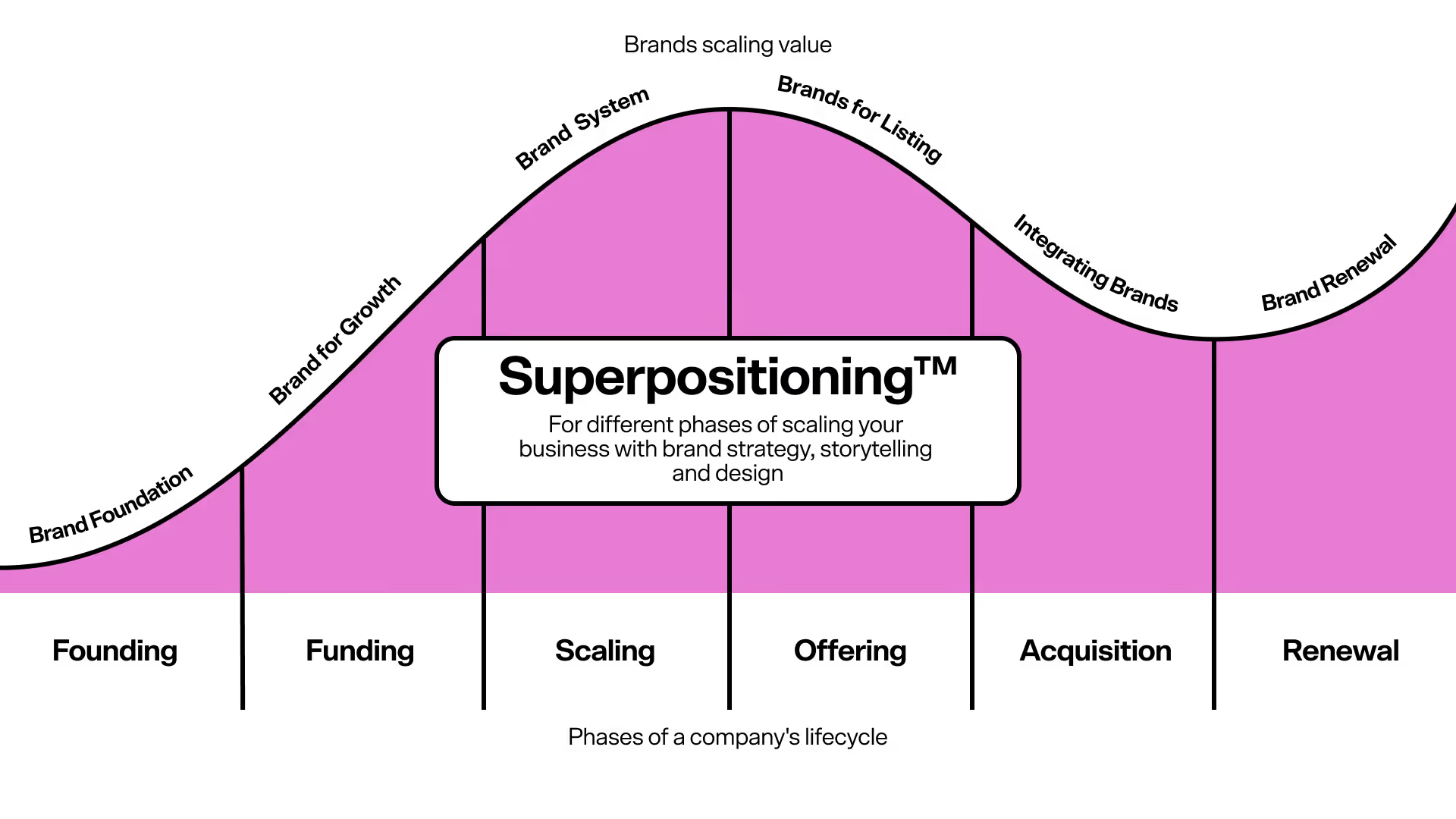
Technology creates the opportunity. Reputation creates the momentum. Brand becomes the moat that remains when the market consolidates.